

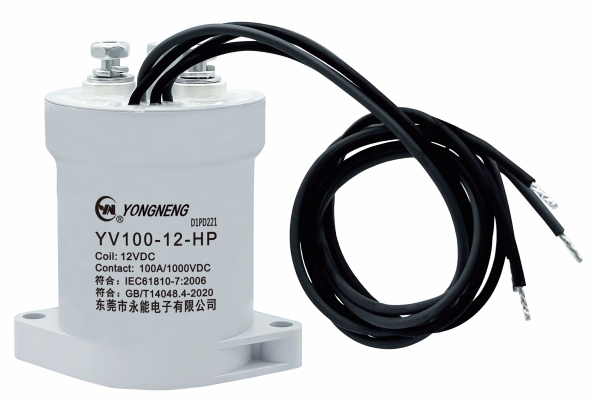
| Parameter | Value |
|---|---|
| Contact rating, resistive load | 100 A |
| Coil rated voltage | 12 / 24 / 48 VDC |
| Auxiliary contact | 2 A at 30 VDC max., 100 mA at 8 VDC min. |
| Endurance | Mechanical 2 × 10⁵ operations; electrical 1 × 10⁴ operations at 100 A 450 VDC, 3 × 10³ at 100 A 750 VDC, 1 × 10³ at 60 A 1000 VDC |
| Coil lead | 300 mm standard, other lengths to order |
Pre-charge circuits are one of the most common uses: the unit closes ahead of a main contactor to bring a DC link capacitor up to bus voltage gradually. In electric vehicles it handles auxiliary DC switching in battery-side distribution and accessory power paths, and in charging systems it switches the DC output inside the cabinet. Solar and energy storage installations use it for string and battery-side switching in storage cabinets and combiner boxes, including branches that are switched in and out as the state of charge moves, while heating systems use it to control DC heating elements and their supply circuits. Distributors often keep the ratings they need on one stock line, and as a relay supplier we can put together a matched set across the line for a machine builder or a reseller.
YongNeng builds relays and contactors at its own production base, and the YV line covers ratings from 30 A to 500 A, so machine builders and distributors can serve several machine models from one supplier. As a relay manufacturer we also take on OEM and ODM work, developing differentiated relay designs and adapting details of the build to a customer's specification. Buyers who need several ratings for one project can have them quoted together instead of splitting the order across suppliers.
YongNeng is a relay manufacturer supplying signal relays, latching relays and high-power relays, together with a high-voltage DC contactor line that runs from 16A up to 400A. Because our range covers everything from light switching duty to heavy DC loads, buyers can consolidate several switching positions with one supplier instead of sourcing each rating separately. Power relays are offered in sealed and open construction, and contact wiring is arranged for straightforward installation. Tell us the current rating, switching duty and mounting space your project needs, and we will help you match the right relay or contactor to your build.
| CONTACT DATA | |
| Model |
YV100 |
| Contact Arrangement |
1A |
| Contact Resistance |
<=1.0 mΩ |
| Contact Material | Silver Alloy |
| Contact Rating ( Res.Load ) | 100A |
| Max. Switching Current | 1000A/320VDC |
| Max. Switching Voltage | 12-1000VDC |
| Max. Switching Power | 320KW |
| Mechanical endurance | 2x10⁵次 OPS |
| Electrical endurance | 1x10⁴次 OPS(100A 450VDC), 3x10³次OPS(100A 750VDC), 1x10³次OPS(60A 1000VDC) |
| Auxiliary Contact Data | |
|
Max.Current |
A2/30VDC |
|
Min.Current |
100mA/8VDC |
|
Contact Resistance |
<=100mΩ |
| CHARACTERISTICS | |
|
Rated Voltage(VDC) |
12/24/48 |
|
Action Time (ms) |
<=30 |
| Release Time (ms) | <=10 |
| Rebound Time(ms) | <=5 |
| Insulation Resistance | Between Open Contacts:1,000MΩ(1000VDC) Between Coil& Contacts:1,000MΩ(1000VDC) |
| Dielectric Strength | Between Open Contacts : 2,500VAC, 50/60Hz 1 min. |
| Between Coil & Contacts: 2,500VAC, 50/60Hz 1 min | |
| Coil End Lead Out Form | Leading 300mm / customized. |
| Ambient Temperature | -40℃~+85℃ ( No condensation) |
| Unit Weight | without auxiliary contact: Approx. 185g with auxiliary contact: Approx. 330g |
| Impact Stability | 196 m/s2 |
| Impact Strength | 490 m/s2 |

Compare the steady current your circuit carries with the 100 A contact rating, which is measured on a resistive load. A load with strong inrush — a motor start-up, a capacitor charging or a lamp load — can pull several times that figure for a moment. Send us the peak the contacts have to break and we will confirm whether this high current relay is the right frame or whether the next rating up in the line is the better match.
Yes. An auxiliary contact set can be fitted for signalling the position of the main contacts, and its rating suits low-level control circuits. As a relay manufacturer we supply both the plain version and the version with the auxiliary contact set, so you can order the one your control scheme needs.
A general purpose relay is normally chosen for lower-power control or signal switching, while a high voltage DC contactor is built to connect and disconnect DC power circuits. This model is the power-side device in that comparison, with the arc-handling construction and the endurance behaviour that DC power switching demands.
No. The contact wiring carries no polarity requirement, so the same unit works whether the circuit runs current forward, in reverse, or changes direction with the operating state. That removes a wiring step during assembly, and a spare held for one machine also fits the mirrored version of the same design.
Coil options are 12, 24 and 48 VDC, so choose the one that matches the control supply your board already provides; in most builds that lets the coil be driven directly instead of through an extra driver stage. As a relay supplier we fit the coil version your project uses, and the contact rating stays the same whichever control voltage you run.
There are no contact faces to clean or adjust, because the chamber is sealed and the switching environment inside stays as it was built. Maintenance in service means checking the power connections and the coil lead, and replacing the unit once its electrical endurance is used up. Tell us your switching voltage and duty so the replacement interval can be planned.